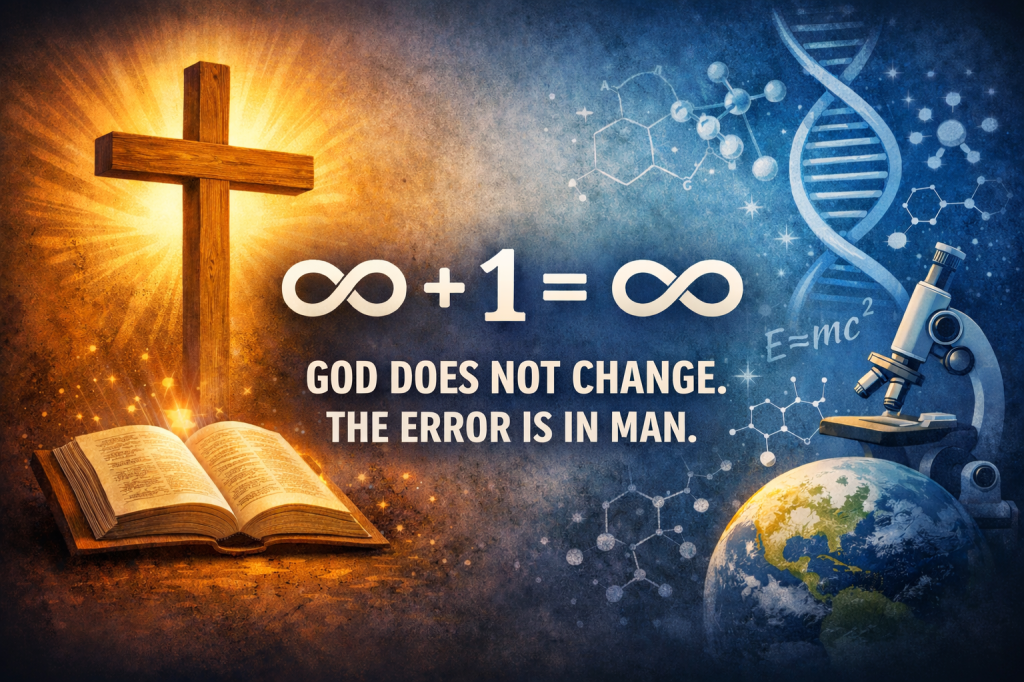
In mathematics, infinity (∞) is an abstract concept—it describes something that has no limits, no end, and no restrictions. It cannot be changed: adding, subtracting, or performing other operations on finite values does not violate its essence—it remains infinite. It is constant in its meaning, because its definition does not allow for modification; any attempt to “change” infinity either has no effect on it, or we cease to speak about infinity at all.
Mathematical infinity is a description of God, who in His essence is immutable.
Immutability: just as infinity in mathematics does not change under the influence of finite operations, God in Christian theological tradition is described as immutable—“the same yesterday, today, and forever” (Hebrews 13:8). Nothing that is finite (human actions, time) can affect His nature.
Infinity: God is often presented as infinite—in power, justice, goodness, or omniscience. This echoes the mathematical ∞, which transcends all finite measures.
In mathematics, we can describe infinity in various ways (e.g., through limits, sets), but its essence remains the same. Similarly, people may describe God in different ways, yet they do not change His essence—it remains constant.
Mathematical infinity is a useful model or analogy for thinking about God as an immutable and infinite being. This is a proof in the strict sense, because mathematics is logic created by God, and therefore perfectly suited to the world created by Him.
For example:
if God = ∞ represents God, then human actions do not change God, just as adding or subtracting some number does not change infinity, which fits the idea that God is beyond human influence.
When people “change” the description of God, in mathematical terms it would be like moving from ∞ to something finite—but then it is no longer infinity, but something else, which aligns with the earlier conclusion about the loss of essence.
Mathematical infinity can be perceived as a description or metaphor of the immutable, transcendent nature of God. It is not something that mathematics “confirms,” but rather something that harmonizes well with such an image.
Enemies of the Church for many years, even centuries, have analyzed how to destroy the Church. They tried to add heresies to doctrine; they tried to subtract truth from teaching. According to the laws of mathematics, infinity does not change, and therefore God also remains unchanged. These are logical statements that cannot be refuted.
The worst part is that Freemasonry and other organizations associated with the fight against Christianity noticed this centuries ago and began externally adding various heresies and deviations from the faith, or subtracting obvious truths. It is known that external actions have the property of diverting attention from internal actions. They began a substitution of faith and the Church.
Balance of the Soul: From Emptiness to Fullness of Life
The attack took place on two fronts: the clergy and the faithful. It is known that no one wanted to lose such a system that controlled people—it was enough merely to change their way of thinking from a Christian mentality to a Masonic one and seize power in the Vatican. An ambitious plan that succeeded so perfectly that it went unnoticed by the majority of the faithful.
As if that were not enough, people, seeing changes that accepted their sins, flocked to the new, modernist Church. All homosexuals, divorcees, etc.—everyone except normal, ordinary people, who, seeing the deviations, leave and withdraw into the shadows.
Abortion became a sacrifice of children, certainly not offered to God.
The temple of Satan in full splendor. We have a grotesque situation in which people say they are opponents of abortion and communism, while at the same time supporting Vatican institutions that promote these ideologies.
Masonic lodges praise the Vatican, while the faithful say they are fighting Freemasonry.
The faithful attend the new Mass, which offends God, is a Masonic, Protestant feast, and they think they are fulfilling the Church’s obligation of participation.
Grotesque—that is, a parody of sound thinking.
The teachings of Our Lord Jesus Christ, if they were known, would expose the lies, but unfortunately they are forgotten, apart from a few phrases torn out of context.
Mathematics—that is, a science that must be consistent with His words—also shows precisely what has been done.
God is no longer equal to infinity—He has been replaced with some constant value to which one can add and subtract whatever one likes. Of course, God is still what He always was, but this has been removed from view. The faithful, looking at the word “God,” no longer see infinity, but something that reflects their sins. As a result, we have as many gods as there are people, and everyone thinks theirs is the true one.
An ideal situation for traitors and Judases who did this.
In mathematics, the principle of non-contradiction applies: one statement cannot be both true and false at the same time. If God created the world, He also created the order and the laws according to which it operates. Science discovers these laws; it does not establish them, and therefore it cannot contradict the One who is their source. When a contradiction appears, it does not concern God or reality, but human reasoning. Just as in mathematics an error does not overturn the laws but reveals a mistake in thinking, so here as well: the problem is not God or science, but a lack of logical consistency.
Just as in mathematics ∞ does not change through adding or subtracting finite numbers, so God does not cease to be true or active, regardless of erroneous human interpretations.
Arkadiusz Niewolski

 Catholic during the Great Apostasy
Leave a comment