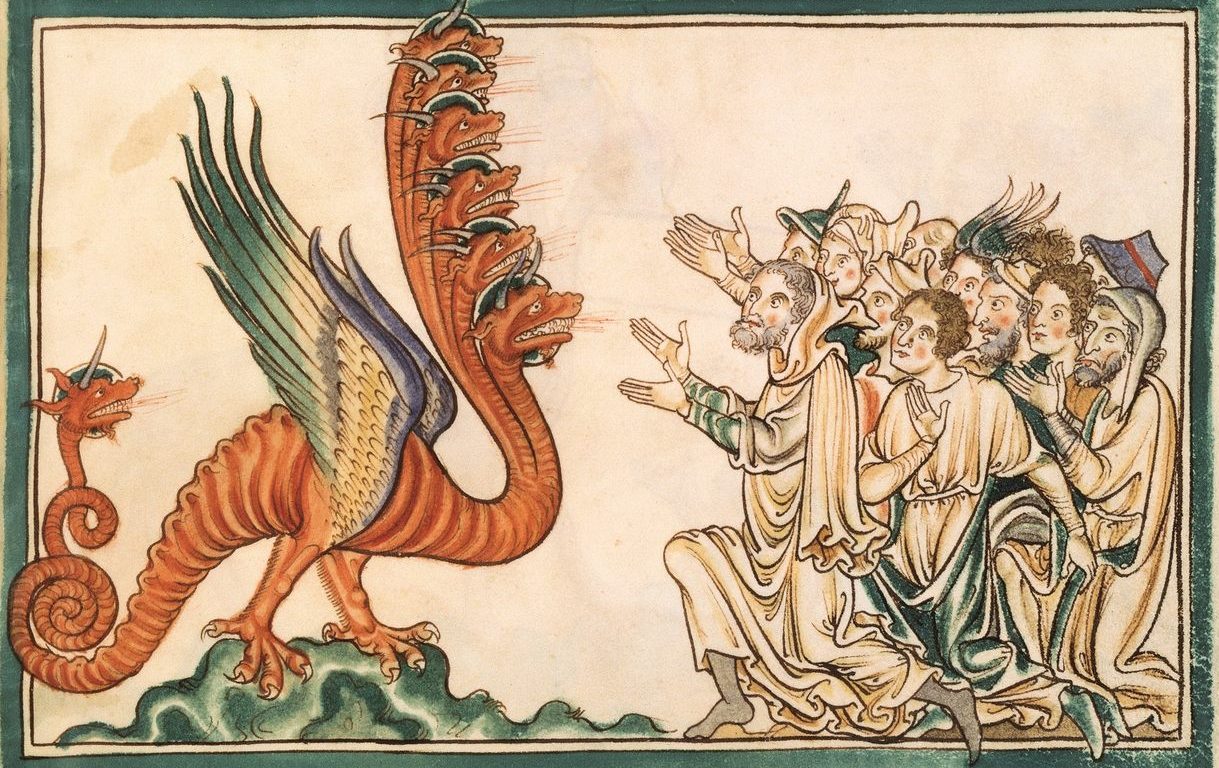
Acts 14:11–15 (Douay-Rheims)
15. “Ye men, why do ye these things? We also are mortals, men like unto you, preaching to you to be converted from these vanities to the living God, who made the heaven, and the earth, and the sea, and all things that are in them.”
Acts 10:25–26 (Douay-Rheims)
25. “And it came to pass, that when Peter was come in, Cornelius came to meet him; and falling at his feet adored.”
26. “But Peter lifted him up, saying: Arise, I myself also am a man.”
From these passages we can see that already in the earliest times of Christianity there existed the problem of misinterpreting and confusing authorities. I will attempt to analyse this psychological inclination of human beings, showing to what disastrous consequences it has led.
One could say that Judas was the prototype of such behaviour. Having God before his eyes, he saw in Him a man—a kind of king or nobleman—who would make him someone important and wealthy. He showed a typically human way of thinking, without the slightest understanding of what Our Lord Jesus Christ was teaching. This led him to betrayal and total ruin. The supporters of the so-called “mercy without limits” should notice that what befell Judas shows clearly that their theories—put simply: lies—are shattered by justice, which reached him even though, in a certain limited, human way, he acknowledged his guilt by wanting to return the money.
We therefore have a situation in which one of the Twelve betrayed, meaning that he completely failed to understand the teaching he heard directly from the mouth of God and of which he was a witness through the deeds He performed. Mathematically speaking, this gives us 8.33% incomprehension at the very beginning. Applying a very simplified statistical model, we arrive today at about 99.6%, that is, practically total incomprehension of the Gospel.
To illustrate this situation better, imagine a rock stretching in a straight line on the horizon. Along the rock runs a road, also as straight as the rock. Over 33 years the road deviated from the rock by 8.33%. According to such a simple scheme, after about 800 years people walk in the opposite direction. They therefore show not only a lack of understanding of Christ’s teaching, but they proclaim things completely opposite to it. Of course, this is only a simplified mathematical model, without considering factors that could slow this process. Yet in 1917, reading the words given in Fatima by the Mother of God, we must be certain that people were already moving in a direction different from God. It was not yet a fully opposite direction, but very close—containing only a fraction of a percent of truth. After that only a few decades were necessary for everything to be destroyed: the Masonic and Communist mentality became a new road leading straight to hell. The understanding of the Catholic faith among the faithful reached the level of a fraction of a percent—meaning over 99% incomprehension.
It is worth paying attention to one thing. This image shows us that the complete downfall of man—walking already in the opposite direction—gives a great opportunity, because one only needs to turn one’s back on all heresies and human ideologies and begin to walk in the correct direction. People who have learned all the lies and apostasies, as well as their consequences, have fewer reasons to look back, because they know they will see nothing there but evil. But those who live in a mixture of illusions and lies blended with truth—and such are the majority—often turn around. And what befalls them is what happened to Lot’s wife: they become frozen like stone in one position, between good and evil, unable to break free. It is known that Our Lord Jesus Christ said that everything that is “in between” comes from Satan.
Promise and Destruction of the Third Temple! – record
The greatest error is the conviction people have that they are infallible. The most serious problem, however, is that the majority believes they are right, having sectarian trust in human ideology rather than in God. This can be seen in their belief in their own greatness. An example is the behaviour reported by our readers regarding modernists wanting to join some group calling itself traditional. Sometimes it takes forms verging on contempt. If someone behaving in such a way knows the whole truth, it means that he has understood none of it and is far worse than those he treats with superiority.
Moreover, anyone who exalts himself—that is, man—is a mental Mason, even if he verbally fights Freemasonry, Communism, or modernism in today’s Church.
In the examples I gave at the beginning, the apostles do not respond to people’s behaviour by saying that they are “representatives of God on earth”, but say plainly:
“We are only men.”
This is very important, because they realise that as human beings they are as fallible as the rest and they convey only what was given to them for free—therefore they do not demand money for knowledge, unlike many of today’s so-called teachers, prophets, or theologians.
Temptations can only be overcome through patience and humility, not through gazing at one’s illusory greatness.
Returning to the main subject: today we have a situation in which the vast majority does not understand the teaching given to us by Jesus Christ. And here another problem arises—most people, hearing that only one percent has understood this teaching correctly, believe that they themselves belong to that one percent. It is clear that reaching people with the truth borders on the miraculous.
Let us remember that a prayer for conversion is a prayer for resurrection—not of the body, but of the soul. And such things can only be done by God. There is no point deceiving oneself and believing today’s charlatans.
No one will ever understand the essence of the Christian—Catholic—faith (please do not confuse this with today’s modernist Church, neither holy nor Catholic; modernism is the cesspool of all heresies) if he does not know the spiritual dimension of faith.
Here it is worth looking at one of the disciples of Jesus Christ—Saint John the Apostle. A man who was very close, yet took another path.
John 21:21–22 (Douay-Rheims)
“Peter therefore seeing him, saith to Jesus: Lord, and what shall this man do?
Jesus saith to him: So I will have him to remain till I come, what is it to thee? Follow thou me.”
If we look closely, we will see the structure, the foundations, and the manner in which the apostles built the Church:
John – contemplation, spirituality, metaphysical depth.
His writings (Gospel, Epistles, Apocalypse) are the most symbolic, inward, directed toward the nature of God, light, truth. He alone does not die a martyr—he lives the longest. He represents the mystical and “inner” current of the Church.
Peter – the “external builder.”
Organisation, structure, office, executive authority. Practical, responsible for maintaining unity within the community. The foundation of the earthly layer of the Church: norms, governance, shepherding.
Paul – the synthesis of both worlds.
He possesses John’s spiritual depth, but also Peter’s missionary and institutional effectiveness. He built the Church’s narrative for the pagan world—rational and translatable into other cultures. His activity brought the greatest number of conversions because he combined spirituality with logic.
John the Apostle represented the spiritual Church, which will outlast everything—just as he lived the longest. He was to show what faith truly is and its spiritual depth. If external structures have collapsed, if logic has been replaced with folly—what remains is what is unchangeable: our souls, the churches built on the rock of faith within our souls.
Is this detached from reality?
No—it is absolutely true.
This is precisely why John wrote the Apocalypse. It is not a description of the destruction we should fear, but of the victory of spirit over matter.
The Temple within the soul has always been the aim of human beings.
Jeremiah lived after the construction of the First Temple, in a time when external cult was developed—and precisely then he taught that:
– the building itself guarantees nothing,
– the true covenant must be written in the heart (Jer 31:31–33),
– God does not look at sacrifices if a man’s life is false.
Jesus speaks of a temple destroyed and rebuilt in three days—symbol of the body and of the spiritual temple.
In His conversation with the Samaritan woman He emphasises that “neither on this mountain, nor in Jerusalem.”
The Sermon on the Mount moves morality from acts to the interior.
Indeed, Jesus Christ says plainly:
“God is a spirit, and they that adore him, must adore him in spirit and in truth.”
And yet people always act otherwise—they look to their own needs and ideologies.
Judaism after Jeremiah returned to structures and rituals.
Christianity after Jesus—especially from the 4th century—adopted an institutional, material, hierarchical model.
This always led to decline and disaster.
But was the destruction of the temples a disaster?
Or was it a descent to the bottom from which one could rise again?
These are questions that lead to the deepening of faith. Questions about external matters make no sense, for they add nothing to building churches within souls.
The problem is that people possessing knowledge of external matters have no understanding of the essence of faith.
If the Temple has two pillars: external and internal, then only when both stand does it stand upright. Only then does Paul have a strong basis for conversion. But regardless of whether people accept the new Mass, the popes, and their present heresies, or do not accept them—that is, regardless of whether the external pillar stands or does not stand—it makes no difference, because without the internal pillar everything collapses anyway.
The proper spiritual position allows one to find the answers.
Therefore I believe that discussions about all heresies and blasphemies make no sense. If the Third Temple—that is, the Catholic Church—has been destroyed, then it is not even worth greeting the modernists who led to this.
Why discuss obvious apostasies? Perhaps only to promote them.
What is needed is the building of churches in souls—upon the rock of faith. Our Lord Jesus Christ built churches first in the apostles: He strengthened their souls, they became internally unbreakable, and only afterwards did they begin the construction of external structures.
But for this to happen, the apostles had to acknowledge that something had ended—that they had died and been born anew. Likewise, the Church will never be reborn until you acknowledge that something has ended, died, and must be born again.
All signs indicate that the Temple has been destroyed. This explains all questions.
So why does no one want to see this?
People are simple like an open book. Saying that they “take care that the sheep do not scatter,” they pretend to be good shepherds. First, such behaviour resembles more a wolf in sheep’s clothing preparing the victims for slaughter. Second—billions of believers are a trough from which one can draw profits as long as they believe that the institutional Church exists.
If someone does not notice these things, it is not because they are hidden or because he lacks intelligence, but because he does not want to see or hear the truth.
The power of the soul is tremendous—it is like a rock from which one can build a castle or from which a destructive avalanche can fall.
Can the soul rule over matter?
Arkadiusz Niewolski

 Catholic during the Great Apostasy
Leave a comment