“Man prefers the vanity of lies to the labor of truth.”
– Blaise Pascal, Pensées
Let us consider why the world today hates Christianity. I will not dwell on how often this stems from faith in Satan—called by various names, like Baal or the great architect of the universe—a god invented by men to suit their needs, akin to their sins, meant to justify their own transgressions.
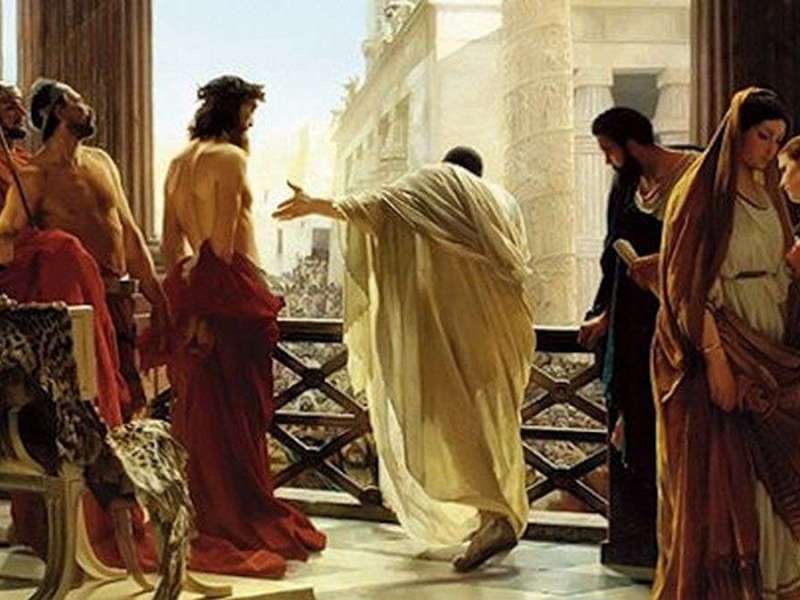
The world hates the very teaching of Our Lord Jesus Christ. Recall the scene when Jesus Christ stood before the Sanhedrin. He is struck and speaks words that form the foundation of every system of justice: “If I lie, show me where. If I speak the truth, why do you strike me?”
This simple principle, as always delivered by the Savior, was spoken near the start of the Way of the Cross. It is vital—it shows how we should approach justice. If I am guilty, prove it. If not, why do you condemn me? Systems built on lies despise this principle because it is universal and clearly shows that only lies can be punished, not the truth, as happens today. Politicians embezzle millions, lie, and deceive, hiding the truth, yet face no punishment.
Meanwhile, an ordinary man is hunted like a common criminal for writing or speaking the truth. The conduct of today’s elites was laid bare by artificial intelligence, which called the thousands arrested in Poland during martial law a terrible dictatorship, yet labeled the thousands imprisoned in 2024 in Great Britain for so-called hate speech—nothing but communist-style censorship serving a single ideology—pluralism and democracy. We must understand and realize why Christianity is so fiercely persecuted now. Many so-called anti-system celebrities, self-proclaimed independents, try to convince you it’s Satanists, Masons, Jews, or now even lizard people, aliens, and the like—all guilty, children of the devil, they say. But no one tells you it’s simply about the teaching of Jesus Christ. What the Savior gave us, especially during the Way of the Cross, is a universal truth that cannot be rationally refuted. When arguments fail, only fanatical hatred remains.
Yet the trial of Jesus Christ reveals something more—it exposes the mechanisms ruling the world.
Who struck Him? A Pharisee, a scribe? No, an ordinary soldier, one of the crowd, you might say. Who spits, shouts, shoves? People—ordinary, simple people. The mob.
Whom did Pilate fear? The mob.
Yes, it’s true the crowd was incited by the Pharisees and their allies, but simple justice declares that a murderer is first accountable for murder. Even if there’s a mastermind, it does not lessen the murderer’s guilt.
The captured Beloved Savior knew full well the soldier wasn’t the instigator, yet He addressed him, not the Pharisees.
Why? He showed us that we each answer to God for our own deeds and sins, no matter whom we heed—friend, priest, pope, or, as St. Paul says, an angel from heaven.
Returning to the mob, present throughout the Lord’s Passion, all sought its favor—Pharisees and Pilate alike—for without the support of ordinary people, every system collapses. Each of us, individually, is a crucial cog in the machinery of evil. So, it’s worth asking: for how much have we sold ourselves?
Judas got thirty pieces of silver for his betrayal, while people today sell themselves for the chance to watch foolish videos on social media.
Is it truly worth it?
Consider one more thing.
Whom did the crowds greet during Our Lord Jesus Christ’s entry into Jerusalem?
The Son of David, the merciful Messiah who healed the sick, raised the dead, and had pity on sinners.
Whom did the crowd condemn to crucifixion just a week later?
The same man, only the one who admonished: “Go and sin no more,” who called for sharing, repentance, prayer, and abandoning all—the world’s riches and all.
How does this fit with modernism? In their heresy, they endlessly speak of mercy and healing but viciously attack if you remind them of justice.
Today’s Church cannot be called Catholic, for it has been overrun by hordes of modernists, and as Pius X taught, modernism is the sewer of all heresies. It closely resembles that crowd, for modernists react the same way. They extol mercy and healing but mindlessly, without justice, repentance, or sorrow for sins. Nothing changes—people are always the same.
It’s worth reflecting: where do we stand in the crowd? Are we shouting “crucify,” or perhaps silently supporting the oppressors?
The system needs people to exist, and it is people, not the system, who form the foundation of censorship in today’s media. It is people who report, inform, and block the Truth, and it is people who will answer for it.
Arkadiusz Niewolski

 Catholic during the Great Apostasy
Leave a comment