Many among the thinkers regarded as the vanguard of progress treat the Church with complete disdain. It is curious that these philosophers seem to forget history, which shows that funeral dirges have been sung over the Church’s grave a dozen times already, almost in unison, yet each time this choir somehow fell silent. The same refrain was repeated time and again, and each time the prophecies failed to come true. Nero said it, as did Arius, Henry VIII, and Voltaire, and now Viviani, McCabe, and Fawkes proclaim with undiminished faith the downfall of the Church. Yet somehow, this Body lives. Oh, they admit it should have died, that it is contrary to reason and experience. Yes, Nero’s persecution should have eradicated it, but somehow it did not; Arius’s arguments were exceedingly rational and should have silenced the Catholic paradox of Jesus, both God and Man, yet they did not; Sabelius’s argument that God, being one, cannot exist in three Persons should have convinced all “thinking people,” yet it did not; Henry VIII and Elizabeth were excellent politicians and stewards of the state, and their policy of destroying churches and desecrating England’s sanctity should have put an end to what they called “papal superstition,” yet it did not; Mr. McCabe’s statistics are brilliantly compiled and clearly prove that such a thing as the Catholic Church does not exist in the world, yet it does; Viviani’s measures are radical and should have settled the matter definitively five years ago, yet somehow it persists; the modernists, supported by serious religious factions, should have had the final word, yet somehow the Pope continues to issue encyclicals. In short, if the Catholic Church were what these people take it to be—namely, a perfectly organized human association, like other states or social organizations—it would have perished long ago, if not under Nero, then under Napoleon. If its dogmas were the result of highly subtle and precise human reasoning, they would have fallen, if not under Arius and Sabelius, then under Voltaire, or at the very least under Father Loisy or Fawkes.
It is a curious thing (as I have already mentioned) that these philosophers, historians, and sociologists seem unaware that their prophecies have been proclaimed a dozen times in the history of Catholicism, yet never fulfilled. Even more curious is that they choose this very moment to repeat them. Fifty or a hundred years ago, they might have had some semblance of an excuse; during the Reformation, even more so; during the Renaissance or the period of the papal sojourn in Avignon, still more. Even forty years ago, when Rome fell and the Pope fled, it might have seemed reasonable to claim that the Church had finally succumbed to a fatal blow, and the predictions—as they said then—had come true. But they proclaim the Church’s downfall now… precisely now!
I know that statistics—mere head-counting—can prove whatever one pleases. Mr. McCabe has demonstrated this, so I have no desire to compete with him. But since seemingly reasonable people maintain that the Church is truly dying, if not already dead, I find it necessary to justify my conviction that not only is this not the case, but that we stand on the threshold of a revival of Catholicism such as the world has never seen.
The religion of the near future, in any case, will not be a watered-down Protestantism, nor the ethical system of the modernists, nor a kind of pious pantheism (which is essentially what the newly discovered theory of immanence amounts to, despite the fact that, in a certain sense, immanence and its corresponding transcendence have been proclaimed by the Church from the beginning). No, none of these will be the religion of the future; rather, it will be dogmatic, disciplined, and papal Catholicism, just as it has been from the beginning of its existence.
1. First, never before has devotion—and practical devotion at that, directed toward what the world considers the foundation of Catholicism’s absurdity, the Sacrament of the Altar—been as strong as it is today. Those who, a few years ago, witnessed the Eucharistic Congress in London must have noticed this. Not only were the streets filled with an immense crowd gathered from all over the world, but even the venerable constitution of Great Britain was threatened. Undoubtedly, other associations could cause trouble with their massive turnout, but I am convinced that none could evoke such feelings of love and reverence on one hand, and such hatred and fear on the other, all because of a small white object considered by half the world to be a mere piece of bread. I have no intention of avoiding discussion on this cornerstone of Catholic faith, but now is not the time for detailed debates. I only wish to point out, for a moment, that the Eucharistic Congresses in London in 1908, in Cologne in 1909—when the papal delegate sailed up the Rhine amid the ringing of bells and the thunder of cannons—and this year’s congress in Montreal were held not to debate the dogma but simply to honor the fact (as Catholics believe) that Jesus Christ, God and Man, takes bread and changes it into His Body, and that this human Body, born two thousand years ago of Mary, crucified on Golgotha, and risen on Easter, is now present under the appearance of bread in London, in Cologne, in Montreal, and in every Catholic church throughout the world. I am not now considering whether this is true or not; I am only trying to show that a time producing phenomena like these congresses, where an international and supranational multitude gathers to honor this fundamental dogma, is poorly chosen for proving the fall of Rome. And if the dogma seems nonsensical and foolish to these philosophers, the phenomenon is all the less understandable. For one cannot regard these devout crowds as a gathering of barbarians and simpletons crazed with fanaticism, since among them are scholars, philosophers, astronomers, doctors, lawyers, soldiers, merchants, industrialists, as well as women and children who, through the simple purity of their hearts, see God.
2. Second, it is true that rarely have the scholars and sages of the world so willingly embraced Catholicism as they do today, provided it is properly presented to them. I have already spoken of this, so I have no reason to dwell on the matter further. Recent conversions in France and England have given the lie to the critics’ claim that the Church appeals only to the simple-minded. True, many scholars who study the Church reject it, and the fact that others accept it does not prove that the Church is indeed what it claims to be. But the fact that some accept it, and these from among those well-versed in all scientific, biological, and other arguments, proves at least that it is not contrary to these things. Father Cortie, a Jesuit astronomer, knows perfectly well that the earth is just one of the planets, yet he believes without difficulty that the Son of God was incarnated on earth. Professor Windle, recently converted, was thoroughly familiar with all the theories and hypotheses about the composition of matter, yet he willingly believed that five words spoken by a priest transform bread into the Body of Jesus. Lord Brampton, a famous judge, knew precisely the inadequacy of human testimony, yet at the height of his success and power, he agreed to be led like a child and to believe and do what others, less learned than he, told him. The professor of history at the University of Halle knows well what can be said about the secular reasons and circumstances that led to Rome’s primacy, yet recently he sat as a disciple at its feet and chose the Church, which he had been taught to criticize and reject, as his Lord and Master. Times marked by the conversion of prominent individuals in all civilized countries of the world are not suitable for proclaiming that the Church is a falsehood, that its claims are unjustified, or that no thinking person could even turn to it for light.
3. The third sign of the Church’s continued vitality is the behavior of those who neither raise arms against it nor for it. I have in mind people who say, “I don’t adhere to any religion, but if I were to follow one, it would be Catholicism.”
This may seem insignificant, but we hear such statements so often (at least I have heard them countless times from complete strangers on trams, trains, or in the street) that it must have some significance. If we press such a person, this “irreligious” individual will usually say, “You Catholics know what you want, and you do what you’re told. You are the same everywhere, you don’t have one religion for one person and another for someone else.”
What does this mean? It means that such a person, in one way or another, has encountered the vitality I have been speaking of. He has discovered, God knows how, that the Church is a living organism, a highly vital one, that it has its own convictions, that it is not a dead principle but a thinking and acting organism, not merely a collection of individuals sharing a common name while differing in everything, not a relic of bygone times or some shapeless conglomerate, but a living Personality, thinking, speaking, and acting as a living person might. He has discovered what I have repeatedly mentioned: that the Church is unlike any other association in this world, and therefore this “irreligious” person singles it out and says, “If I were anything, I would be a Catholic.”
We ask, then, is this the appropriate moment to proclaim the Church’s downfall, when not only its disciples but even the stones cry out—those inert and lifeless souls that still have enough power to sense its vitality? If the Church were truly dead, would people speak of it this way?
4. Finally, I would like to draw attention to something I have already discussed at length, namely, that the Church’s ancient theories about extraordinary phenomena are today being confirmed by science.
We live in an era of psychological research. Scholars from various fields believe that psychology can greatly contribute to the advancement of science. Biologists are coming to the realization that consciousness is the foundation of their science; historians are discovering that events must be judged according to the characters of their witnesses, and since characters are complex, not simple, events must also be complex. Medicine now knows that a patient’s disposition has at least as much influence on the course of treatment as the prescribed remedy. Thus, a psychological school has emerged, hoping to one day find the key to all these mysteries, yet it stumbled at the outset on the fact that the strongest motivator of the human mind is religion, and that, in particular, the Catholic religion, which has continuously witnessed this fact, provides extraordinary and most fascinating phenomena. All the ancient truths known to Catholicism since the time of Christ—the healing power of faith, abnormal physical states caused by the state of the soul, influence at a distance, the appearance of the dead, the possibility of what might be called a splitting of personality within one organism—all these phenomena, upheld by Catholicism and previously dismissed with contempt by science, are now recognized as certain facts, fully deserving of consideration if progress is to be made.
Is this, then, a well-chosen moment to speak of the “death” of the Catholic Church? Even modern psychologists have discovered its astonishing vitality and power—a power of suggestion, if one prefers to call it that—which no other body has ever had or expected to have.
It seems to me that one could endlessly cite new signs of vitality. It could be shown that the Church has been the balance of societies, the only weapon against anarchy, the sole protector of family life, the inspiration of art, and the only opponent of the suicide of races in the past, and that it will be so in the future as well. Ultimately, it alone has managed to preserve from the past what was worth preserving; it protected the music of the ancient world from vanishing, preserved and transformed the architecture of the old world, while also creating its own, which must be the starting point for further progress; it saved Greek and Latin, using both in its books and prayers; it successively adopted philosophical systems to proclaim its truth. In short, it was the creator of the entire civilization we know, and where it has been removed, that civilization declines. Compare the Luxembourg Museum with the Louvre, one pagan, the other Christian, and honestly say where the finer art is. Or set the ideals of Equality, Liberty, and Fraternity, as they are now understood in France, against the same ideals, but understood differently in the age of chivalry, and ask ourselves which were better for society. These questions, however, are too vast and complex to be thoroughly discussed here. I only note that I am not afraid of the outcome if the question is posed honestly and answered honestly.
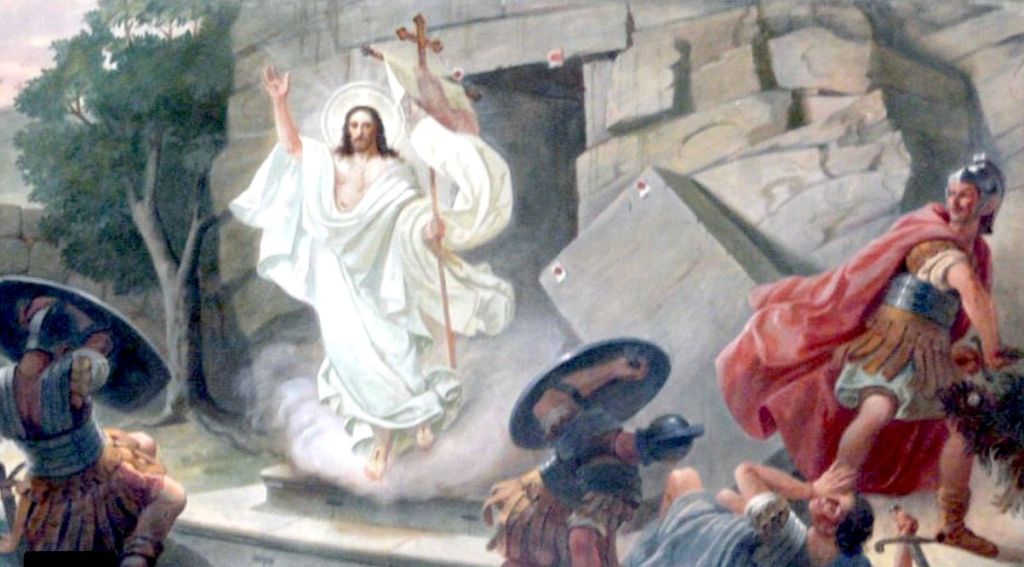
Thus, my final argument—and it was raised by Christ Himself in the end—is the argument of the Resurrection, for nothing can rise from the dead except by divine power.
We have seen how, in various respects, the life of the Catholic Church strangely and wonderfully corresponds to the life of Christ. We have observed the characteristics of those who reject it and those who accept it: those who accept it—simple folk on one hand, scholars on the other; those who reject it—mediocre minds, knowing too little to recognize the limits of science. And we have seen that these categories correspond to those who accepted or rejected Christ. Then, noting the trait of hiddenness and contemplation so prominent in the life of Christ and the life of the Church, and seeing that it is evidence of an awareness of something beyond the sensory world, we considered the content and manner of teaching in the Gospels and the Church. In all respects, the content was the same, and these astonishing points provoked and continue to provoke the same protest. And the manner of teaching is identical, a confidence that can only stem from an awareness of possessing absolute Truth, a confidence that is an essential characteristic of such awareness.
Next, we discussed the element of the miraculous, identical in both. We noted that the Master who called Himself God had to perform these signs, and that the world, rejecting the Master, must explain them, as Christ’s critics did then and as the Church’s critics do today. Further, we examined more closely the characters of those who reject divine teaching in all ages: Caiaphas, the representative of religious but purely human associations; Pilate, the type who believes Truth is something highly inaccessible and rare; and Herod, the type for whom Truth is a sensational and extraordinary phenomenon.
Later, we saw how the great wielders of the world’s energy—admirers of Law, seekers of Truth, and lovers of Beauty—despite their different ideals, unite in condemning Him who said He was the Way, the Truth, and the Life, and that all these thinkers, hostile to one another in everything, agree in one thing: in rejecting and condemning Catholicism as their common enemy.
Finally, we looked at the failure of Christ and the Church and tried to understand whether the ultimate tragedy of Golgotha in all ages was not a necessary condition for success from a divine perspective, whether Love must express itself through pain, and whether Christ must be buried before triumphing over humanity’s enemies.
Anyone familiar with history knows that the Church has not fared better than any other association. Everywhere and constantly, it has been oppressed by heretics, persecutors, critics, and secular authorities of various kinds. It has not succeeded in fully satisfying any human impulse; it has failed (as its enemies say) or transformed (as its friends say) every demand placed upon it. Apart from its true friends, the Church satisfies no one; no one finds in it the degree of humanity they desire. It always repeats the world’s cry: “I thirst,” always despised, always dying, abandoned by God and men even in the very moment of death, always buried, hidden under a tombstone and seals, always placed by the world alongside other forms of faith that have descended or are descending into the grave.
And yet it lives!
Once again, we have seen that so-called modern thought in every age and in our times has pronounced a death sentence on the Church, indeed, declared it nonexistent. And at the same time, we see that it lives with a vitality unique in human history. And in this moment, when “wise and reasonable” people proclaim its demise, other wise and reasonable people turn to it as the source and life of knowledge; that in this moment, when crowds turn away from it, entire multitudes turn to it as their Mother and Lady; that its devotion has never been more fervent, its discipline more perfect, its hopes more far-reaching. The last three hundred years—a short time in its history and for it, which lives from the beginning and will live to the end—have seen the rise and fall of countless sects, but it endures as it was, unchanged.
Other religious associations have recognized the need for new dogmas and concepts to refresh thought, as Arius, Sabelius, Voltaire, Father Loisy, and others did; it alone holds fast to the old, and simultaneously, with the fall of these new religions tailored to the times, it stands firm, unyielding; it has so many faithful, it holds sway over a number of countries that these new religions could not even dream of.
I do not for a moment expect the whole world to become Catholic; I know it is not so, and I even believe we are approaching a great apostasy. But I am certain that in fifty years, there will be no body in the Christian world capable of rivaling the Church, and in a thousand years, if the world still exists, the situation will be similar to the present.
On one side will stand the world arrayed against it in serried ranks, in which there will not be two people agreeing on any point except their hatred of the Church. There will be various new theologians, as there are today, new philosophical systems constantly changing, new discoveries, new revelations, new methods and combinations of fragments of ancient truth.
And on the other side will stand the eternal Church with even clearer marks of the Passion.
From there will resound that eternal cry: “We finally know what it is; all have abandoned it except a few fanatics; it is dead and buried.” Thus will the Church stand, as always, sorely wounded yet living, betrayed by new Judases, judged by new Herods and Pilates, scourged by those who pity it with every lash, despised and rejected, yet stronger in its divine madness than human wisdom, suspended between heaven and earth, yet conquering heaven and earth, guarded and sealed in its living tomb, yet always awakening to new life and new victories.
In the distant future—as now and as in the beginning—there will be quiet gardens, and in them, He, loved and known, will comfort the penitent at the dawn of the Resurrection; in upper rooms, His weeping friends will gather and lock themselves in fear of the Jews, and He will enter, stand among them, and give them Peace; He will walk on roads and lakes, as He has always walked in the secret splendor of the Resurrection.
And the cycle will turn again, Bethlehem will appear, where He is born time and again, the kings of the earth will bring their glory and honor, and at His feet they will lay their gifts alongside shepherds who have nothing to offer but themselves. And the ancient and eternal story will repeat in every new civilization that is born and then dies; the ancient drama, where the Love of God stoops to the needs of man, will be played again.
The Church has seen the rise and fall of many dynasties, many monarchies and republics; in the future, it will undoubtedly see, on one hand, socialism—the tyranny of society over the individual—and on the other, anarchy—the tyranny of the individual over society. It has already seen many different theories of life arise and pass, yet it, Life itself, remains the same.
It has seen thousands of philosophical systems and semblances of Truth, yet it—Truth—is unchanging. It has seen all this and will see much more, but it will see the end of them all before the final moment comes, before this mystical Body of Christ, which it is, reaches the stature and measure of Christ, its eternal destiny and unchanging hope. For its ultimate and supreme proof is this sign of the prophet Jonah, this miracle of the Resurrection, on which it has always relied, and which has never yet failed it.
We have seen that, with effort, the Church’s miracles can be explained; various excellent reasons can be found to account for its success in uniting people divided by nationality; psychological arguments about the influence of suggestion on various temperaments can explain its holiness; its philosophy can be countered with another philosophy, its statistics with other statistics, its arguments with other arguments. But can any explanation be set against the phenomenon of its eternal resurrection? Can one, relying on social or earthly principles, explain the fact that, despite undergoing failures that no other religion or authority has faced, it is far more vital than they?
And how does one answer the fact that it is as young and active as it was a thousand years ago, that it poses as great an obstacle to worldly politicians, that it is as much an offense to those seeking an ideal other than its own, as scandalous to its critics as it was when Nero ruled, or Elizabeth tyrannized, or Arius or Voltaire mocked it?
Behold, I see in its eyes the gleam of the eyes of God, and in its mouth I hear the words of God. In its hands raised in blessing, I see the wounds that bled on Golgotha, and its feet, resting on the steps of the altar, bear the same scars as the feet kissed by Magdalene. When it comforts me in the confessional, I hear the voice that told the sinner to go and sin no more, and when it reproves or punishes me, I tremble and step aside with those who departed one by one, leaving Jesus and the sinner alone. When it calls the world to itself, I hear the same voice that said, “Come to Me, all of you” (Matt. 11:28), and when it rejects those who claim to serve it but do so on their own terms, I see the same flash of indignation as when, in anger, He drove the merchants from the temple courts.
When I look at it among its people, applauded by a crowd always ready to praise the rising sun, I see palm branches over the Church’s head and, seemingly close by, the City and Kingdom of God, yet separated by the Kidron Valley and the Garden of Gethsemane; and when I see it covered in mud, spat upon, and bound, I read in its eyes the wish that we weep not for it but for ourselves and our children, for it is immortal, while we are mortal. When I look at its pale and bloodless body, I smell the fragrance of balsam and trampled grass in the garden near the place where it was crucified. And when, at last, I see it walking in the light of each new dawn or in the glow of sunset, as dynasties rise and fall, I understand that He who died has risen once more to bring healing to the wounded, comfort to the suffering, and that He comes not heralded by the blare of trumpets and drums, but in the silence of the night, when His enemies sleep, and His friends keep watch in sorrow.
And seeing this, I understand that the Resurrection is a new Bethlehem, that the cycle closes and returns to its beginning, that the battle will be fought again, for nothing will convince them, not even His daily Resurrection.
**R. H. BENSON – CHRIST IN THE LIFE OF THE CHURCH, PUBLISHED BY ST. WOJCIECH BOOKSTORE, 1921**
1) Written in 1910 before the Eucharistic Congress in Vienna.
2) A. von Ruville.

 Catholic during the Great Apostasy
Leave a comment