
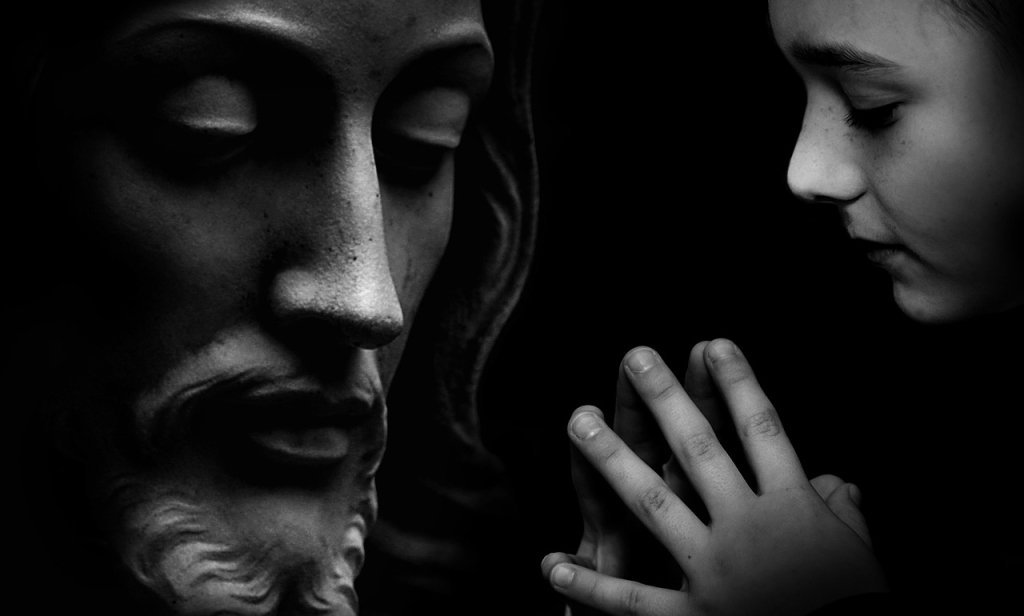
We will see this more clearly if we consider that we feel something different when addressing or speaking of our friends when they are present, and something different when they are absent. Their presence is a point of reference for us; it acts as an external law that shows us what to do and what not to do, what we should not do and what we should do differently, or what we should only do to such and not to such an extent
This is what most people are currently missing in their religious life – this kind of outward constraint that comes from an awareness of God’s presence.
Consider, I say, how differently we speak of a friend, however close, when he is present or absent; consider how we would feel if it so happened that we began to speak of him as if he were absent and suddenly realised that the opposite was true. How would we feel then, even though we would not even think about anything other than friendly love and devotion?
But there is a tone of voice and a way of speaking about absent persons that should be considered disrespectful, and ultimately insolent, if used in their presence. When something like this happens, we wonder to a greater or lesser degree, if only in a not entirely conscious way, how our words would be received by absent persons, what impression it would make on them and – on the other hand – what they would say to us and what they would think of us.
When someone is not present, we are perhaps tempted to quietly say what we think about their views – but in their presence we are careful with our words, preferring to leave out uncomfortable issues, whether because we clearly realise that we may be wrong and that this person may get into a polemic. We are very careful about saying what we think about her beliefs on an issue or how she relates to us; in all these matters, we recognise our reverence and subtlety in our behaviour towards that person.
So, if we feel this kind of awe towards our acquaintances and friends, what should we feel in the presence of the Omniscient, all-pervading Judge of men?
The respect and prudence we maintain towards people become the fear of God towards the Almighty; and those who do not feel this fear, in short, do not believe that He sees and hears them.
If it were otherwise, they would stop complacently boasting about His favour to them, stop telling how intimate their relationship with God is, stop dwelling on His mysteries, stop treating God’s Name lightly and stop addressing Him with inappropriate confidentiality.
Such meditation is, in fact, an unceasing, continuous thinking of Jesus Christ, of His deeds and passions. It means abiding before Him with our thoughts, as before the One whom we can contemplate, adore and towards whom we can turn when we get up, lie down, eat and drink, when we are in and out of the house, when we are working, walking, ultimately – when we are alone, or again in the midst of people; this is what meditation is. And only in this way, no other, will we be able to fill our hearts in the right way.
We are a people with hearts of stone, hearts as hard as a street pavement; the life of Christ leaves not a trace on them. Therefore, if we wish to be saved, our hearts must be tender, sensitive, enlivened; our hearts must be contrived, ploughed like soil, dug up, watered, tended, cultivated, until they become like a garden, a garden of Eden, worthy of the approval of our God, gardens in which the Lord God will be able to walk, in which He will be able to dwell; gardens filled not with wild bushes and thorns, but with fragrant and useful saplings of heavenly trees and flowers. Deserts and barren wastelands must be irrigated by streams of living water.
Such a change must take place in our hearts if we wish to be saved; what we have in the world cannot by any means come from the world, from nature, and this is faith and love.
Christ is gone, we can’t see Him; we have never seen Him, but only read and hear about Him.
There is an old saying: “what is out of sight is also out of mind”. Be assured: it must be so, and it will be so with us, with our relationship to the blessed Saviour, if we do not make a constant effort to think about Him, His love, His precepts, His gifts and His promises throughout the day.
We must constantly call to mind what we have read about Him in the Gospels and devotional books; we must return to what we have heard in church; we must pray to God to enable us to do this, to bless us in this, to make us capable of praying like this in simplicity of mind, sincerely, with a reverent spirit. In a word, we must meditate, it is all meditation, and even the least learned person can and will practise it if he finds in himself the will to do so.
One or two meditations on Christ will not do it.
The transformation of the heart takes place silently and steadily, growing with His image before the eyes of our soul, so that step by step we acquire a little warmth, light, life and love in our hearts.
We should not look in the mirror for a sudden change. It will be like the leaves blossoming in spring. You can’t see them growing; you can’t detect it by brief observation. But every day that passes, something happens to them; you may be able to tell each morning that they have blossomed more and more fully. And so it is with our souls; not every morning, of course, but when a certain period of time has passed, we can perceive that there is more life in us and that we are more religious than before, although in the meantime we were not aware that we were developing spiritually.
St Augustine

 Catholic during the Great Apostasy
Leave a comment