St. John the Evangelist, describing at length and thrillingly the last speeches and teachings of the Lord Jesus to His disciples in the Upper Room, after the establishment of the supreme mystery of our Holy Faith, does not cite whether the Blessed Virgin was present at this farewell and heard the words of the Lord Jesus. However, it cannot be doubted that the content and meaning of these speeches reached the One who pronounced at the very beginning of her Son’s teaching profession: “whatever He commands you, do.”
The words of the Lord Jesus preserved in the Gospels, not only that they are full of meaning and as treasures of guidance of conduct should serve us, but they are also full of beauty and beating with truth and simplicity. To ponder them should be our greatest joy and highest teaching.
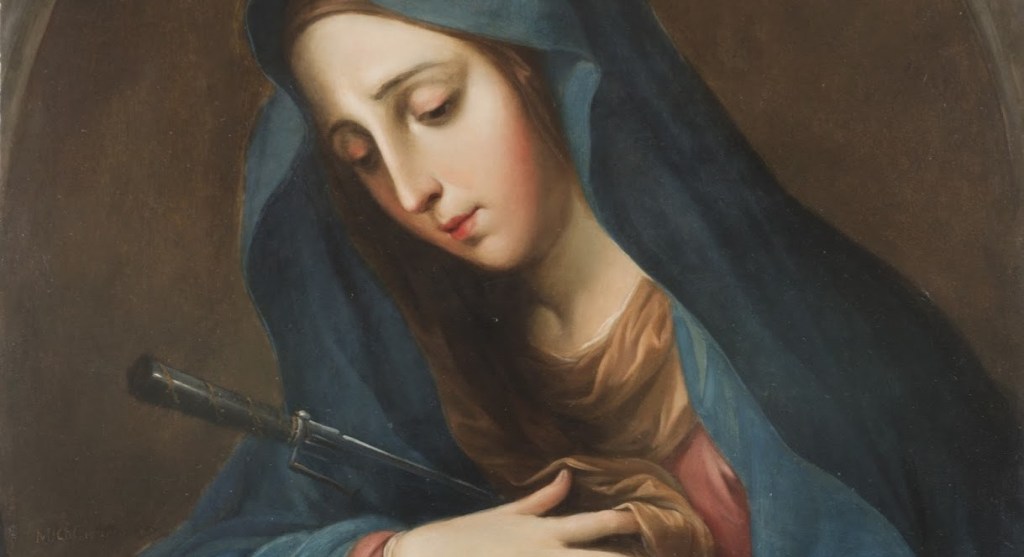
Mary had great faith in the words of the Divine Savior, this is shown to us by her behavior at moments when the Lord Jesus spoke to her.
In the Jerusalem Temple, to the Mother’s excuse that the child’s absence troubled her, the twelve-year-old Jesus responds as if with reproach: “Did you not know that in the things of my Father it is necessary for me to be”.
Mary does not dwell on the words, but recognizes the rightness of the divine sentence uttered by the child and… remains silent.
So also in Cana at the words: “My hour has not yet come,” she does not respond: “Thou art God and all hours are Thine”, but also remains silent and obtains the miracle demanded. At the cross, she accepts the sentence of separation and the sonship of John, and with it takes charge of all people and still remains silent.
How much meaning in Mary’s silences, what a thread to ponder in the words of the Lord Jesus. It would be necessary for us to familiarize ourselves more closely with the Scriptures and to taste the life of the Gospel, many benefits would grow from there for our souls.
– Faced with the words of Jesus and the silences of Mary, we would learn both to speak and remain silent, and in this we are said to be weakest.
II. The temptation to talk, lost man by throwing him into original sin.
.
It took the coming of Mary to rectify the guilt committed by speech, through holy words and holy silence.
” Itching ears” and itching tongues today, need radical treatment; our imperfection beats away at us through unheeded, unnecessary words, spoken and written. And so far from understanding our own disadvantage in this, we pride ourselves most often on what compromises us most.
Talkativeness does a great disservice to the dignity for which we end up claiming a great deal. There is certainly nothing costly in a closet that is open to the public, and likewise there is nothing profound in a person who ventures out to everyone.
The talkative are perpetually indiscreet, having no time to think before they say what they will say, unable to pick up and consider what they have already said.
A sadder still species of unsteadiness in speech are people endowed with a critical sense, that microscope applied to the straws in another’s eye. Such people can no longer be accused of lightness in judgment, for they judge hard; – their word hurts, their judgment stigmatizes, their opinion settles like rust and sinks into human memory. Improvement from this is very hard, it must begin from the ground of the heart at home, from difficult and arduous reparations by rectifying what one has renounced and by humbling oneself deeply before God.
We will never by our own strength rise from this addiction. Crying out for God’s help is so effective in our improvement that already an earnest, sincere plea for virtue is its beginning, is its first act. Let us never forget this and, turning to the Mother of all consolations and graces, let us cry out:
O Mary silent and meek, be our model; – simplify for us the word that soothes and does not injure, simplify for us also the silence that teaches and edifies, and may we obtain this from your Divine Son through you.
Practice: I will make an examination of conscience today from my words.
Rozmyślania na każdy dzień maja. Zapiski z konferencyj majowych ks. Zygmunta Goliana. Dodano najwyborniejsze modlitwy i pieśni do Matki Najświętszej. Kraków 1931. Wydawnictwo Księży Jezuitów, str. 152-157.

 Catholic during the Great Apostasy
Leave a comment